

Adrianne is a Senior Admissions Counselor and TV/film director, producer, writer, and actress currently based in LA. She uses her experience in multiple disciplines to help students achieve their personal and academic goals.
Welcome to the Dartmouth College supplemental essay prompts for the 2025-2026 application cycle! Here’s everything you need to know to write the best Dartmouth supplemental essays possible to increase your chances of admission to the class of 2030.
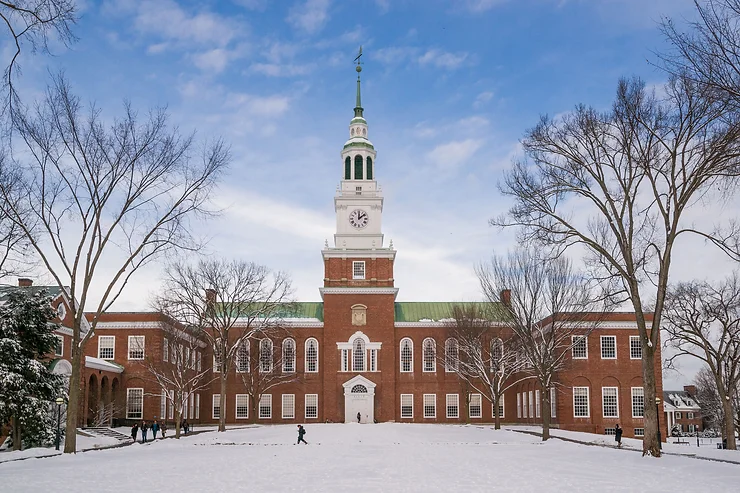
As one of the Ivy League schools, Dartmouth is one of the most competitive schools in the country, with acceptance rates around 6% for the Class of 2029 and 5.3% for the Class of 2028. The college, which is not part of a larger university with grad schools, unlike many comparable schools, is known for its small class sizes, rigorous academics, and uniquely rural setting in New Hampshire.
You can refer to the Dartmouth College website if you want to see how exactly they’re presenting their essay prompts for this year. Here’s how you can write your Dartmouth supplemental essays to stand out from the crowd.
Dartmouth’s writing supplement requires that applicants write brief responses to three supplemental essay prompts as follows:
1. Required of all applicants. Please respond in 100 words or fewer:
As you seek admission to Dartmouth’s Class of 2030, what aspects of the college’s academic program, community, and/or campus environment attract your interest? How is Dartmouth a good fit for you?
This is a typical “Why This College” question, but your response has to be very, very short. Do your research on Dartmouth and make sure you come up with some concrete examples of why Dartmouth is the place for you, and don’t just say that you wouldn’t mind being in the middle of nowhere for four years. Make sure your reasons for wanting to attend Dartmouth are in line with your own personal narrative. Consider three main areas: academics, extracurriculars, and campus life. Research classes and find specific professors that fit your unique interests and aspirations. In other words, make sure your points are authentic and that you’re not simply pandering to that small college that some love.
2. Required of all applicants, please respond to one of the following prompts in 250 words or fewer:
A. There is a Quaker saying: Let your life speak. Describe the environment in which you were raised and the impact it has had on the person you are today.
The great thing about this question is that it’s so open-ended it can be about almost anything. You’ve already written your Common App essay, but hopefully, you have another subject for a personal story up your sleeve, and now would be the time to use it. Use this opportunity to discuss a personal story that encapsulates your environment — which could mean your family, your actual geographical location, your school, your church, and much more! — and its impact on you. In other words, talk about whatever you like, as long as it’s personal and uniquely you. Use your restricted word count wisely by sticking to one main anecdote.
B. “Be yourself,” Oscar Wilde advised. “Everyone else is taken.” Introduce yourself.
To write this Dartmouth prompt well, forget the urge to impress and aim instead to recognize yourself on the page. This is not a résumé in disguise or a highlight reel — it’s a portrait. Start by choosing a lens, not a life story: a habit, contradiction, obsession, voice, or question that quietly governs how you move through the world. Quirk is welcome, but only when it’s earned. Use humor, specificity, or an unexpected structure (lists, fragments, faux footnotes, an interrupted narrative) to mirror how your mind actually works. Let the reader feel your presence through concrete details: what you notice first in a room, what frustrates you irrationally, what you care about when no one is watching.
As you write, resist explaining why you’re impressive; instead, reveal how you think, wonder, and respond. Vulnerability beats polish here, but it should be intentional. You want to be self-aware, not self-indulgent. The strongest versions subtly gesture toward growth or curiosity without announcing it outright. End with a note that feels open rather than conclusive, as if the essay is a conversation starter, not a thesis statement. If someone who knows you well could say, “This sounds exactly like you,” you’ve done it right!
3. Required of all applicants, please respond to one of the following prompts in 250 words or fewer:
A. What excites you?
Truly revolutionary figures, whether in the sciences, technology, art, or anything else, are always very passionate about what they do. Whether it’s the thousands of hours the Beatles spent practicing or Marie Curie’s late nights in the lab, there’s evidence of that deep interest in their habits. It would benefit you to show the admissions officers two things here: first, that you have already worked to identify some of the things that drive you, and second, that when you pick something, you truly go after it. Don’t just talk about how cool it is that black holes don’t even let light escape — go further and discuss how you followed up by interviewing astrophysicists or staring through the cheap telescope you got for your birthday every single clear night. This combination will best present you as someone likely to make the next breakthrough.
B. Labor leader and civil rights activist Dolores Huerta recommended a life of purpose. “We must use our lives to make the world a better place to live, not just to acquire things,” she said. “That is what we are put on the earth for.” In what ways do you hope to make—or are you already making—an impact? Why? How?
This prompt feels a lot like “What excites you?” in my mind, just with an added specification of making an impact on the world. Maybe one calls you more strongly than the other, but you can approach the prompts similarly.
Think about the most likely way for you to meaningfully impact the world. What does it look like? Does it involve “creating” a lifesaving biomedical device, a nonprofit that provides banking services for the homeless, a movie about new environmental technology, or something else (probably something else)? Is there something you have already created that was a formative experience for you? For an effective response here, you’ll want to hint at how you might achieve your vision in addition to describing your motivation and outlining what it is you hope to create. How have you already started working on that goal in your existing work?
C. In an Instagram post, best-selling British author Matt Haig cheered the impact of reading. “A good novel is the best invention humans have ever created for imagining other lives,” he wrote. How have you experienced such insight from reading? What did you read and how did it alter the way you understand yourself and others?
Obviously, this essay prompt is a great choice for avid readers. If that doesn’t apply to you, don’t force it. If this fits you, anchor the essay in one specific reading experience, not a lifelong love of books. Begin by naming the novel, the scene, even the page number, and briefly situate us in when and why you encountered it. Then shift quickly from what happens in the book to what happened to you.
Dartmouth is looking for evidence of imaginative empathy, so show how inhabiting another life challenged an assumption you held or gave language to a feeling you hadn’t yet articulated. The strongest essays trace an internal before-and-after, which means how you saw yourself or others before reading and how that perspective subtly (but meaningfully) changed as a result of reading. Use concrete moments from the text — a character’s decision, a line you underlined, an ending that unsettled you — as mirrors rather than summaries. How has this changed how you move through the world? Keep the tone reflective and personal rather than literary-critical; this is about transformation, not analysis. Leave the English paper language at the door!
D. The social and family interactions of wild chimpanzees have been the focus of Dame Jane Goodall’s research for decades. Her understanding of animal behavior prompted the English primatologist to see a lesson for human communities as well: “Change happens by listening and then starting a dialogue with the people who are doing something you don’t believe is right.” Channel Dame Goodall: Tell us about a moment when you engaged in a difficult conversation or encountered someone with an opinion or perspective that was different from your own. How did you find common ground?
Yet another prompt this year about difficult conversations and finding common ground! To approach this prompt, think less about conflict and more about connection under tension. Choose a moment where the disagreement mattered, such as values, ethics, lived experience, not a casual difference of opinion. This isn’t asking about a trivial matter, so begin by clearly and respectfully presenting both perspectives so the reader trusts your fairness. Then focus on the process of engagement. How did you listen? How were your opinions challenged? How did you challenge others? Why did that matter?
The Jane Goodall quote matters here! Show how that change (or understanding) emerged through dialogue, not persuasion or victory. Common ground does not need to mean agreement. Instead, it might be mutual respect, shared goals, or a clearer understanding of why someone believes what they do. Reflect honestly on what the conversation taught you about yourself and how that lesson now informs how you approach similarly difficult conversations, since you very well might get into similar conversations at Dartmouth. End by indicating how this experience prepares you to participate thoughtfully in diverse communities where listening is as important as speaking.
E. Celebrate your nerdy side.
Take the word “nerdy” to mean something broader than what you might be picturing. Translation: this doesn’t need to be about an academic class or subject. It certainly could be, but we need to be able to feel your enthusiasm and passion for the topic at hand through your writing. If you do choose a class or subject, talk about how you went above and beyond to learn about the topic at hand.
If you’re not sure what to choose but are determined to choose this prompt, think deeply about the subjects that you could think or read about for hours on end. Maybe it’s a niche interest, or maybe it’s just a specific idea within your overall area of focus. This is the place to “nerd” out!
F. “It’s not easy being green…” was the frequent refrain of Kermit the Frog. How has difference been a part of your life, and how have you embraced it as part of your identity, outlook, or sense of purpose?
To write this essay well, redefine “difference” on your own terms. It doesn’t have to be the most obvious or externally visible trait. Often, the strongest essays focus on a difference that shaped how you see the world rather than how the world sees you. Introduce the difference through a lived moment rather than a label. Put us in your shoes and help us empathize with the difficulty this difference may have or may still cause.
Then trace the evolution (remember, you need a clear beginning, middle, and end in every essay!): how you first experienced this difference, the tension or discomfort it created, and the choices you made in response. The heart of the essay should show how you embrace this difference, not just that you accept it. How did this difference become a source of perspective or purpose? Be reflective rather than celebratory; admissions readers value nuance over triumph narratives. How has this new understanding of your difference impacted how you move through the world? How has it impacted how you see others’ differences?
G. The Mindy Kaling Theater Lab will be an exciting new addition to Dartmouth’s Hopkins Center for the Arts. “It’s a place where you can fail,” the actor/producer and Dartmouth alumna said when her gift was announced. “You can try things out, fail, and then revamp and rework things… A thing can be bad on its journey to becoming good.” Share a story of failure, trial runs, revamping, reworking, or journeying from bad to good.
Everyone loves an underdog and/or comeback story, and if you’ve got one that immediately comes to mind, this question is a great option. You may think that you only want to talk about your wild successes on your application, but sometimes, telling a story of failure and perseverance can say much more about a person’s character.
Now, what you consider a “failure” is important here — if the failure is getting a B+ instead of an A- in a math class… It’s time to think bigger. That’s like saying in a job interview that your biggest flaw is that you “work too hard.” That being said, you don’t want to paint yourself in a bad light, so this can be a tough line to walk. And, most importantly, you want to make sure that there is a happy ending. Maybe you didn’t technically “win” in the end, but you learned something about yourself and reshaped your perspective. How have you used criticism or failure to redirect your efforts to achieve something in a more productive direction? This is especially a great option for student entrepreneurs who had to test products or face rejection when getting their ventures off the ground.
As always, our college admission consultants are here to help. Don’t hesitate to reach out.